Remote Sensing Research
Cheyenne Bottoms, Kansas

James S. Aber1 and Susan W. Aber1
Firooza Pavri2 and Robert Penner3

Table of Contents
Introduction Overviews
Vegetation Initial study
Continuing study Latest study
Authors References

Introduction

Cheyenne Bottoms is the premier wetland of Kansas. Located in the center of the state, it is considered to be among the most significant sites for shorebird and waterfowl migration in the United States (Zimmerman 1990). The "bottoms" is famous for great flocks of migrating waterfowl that include many rare and endangered species. The site is an important point for rest and nourishment for hundreds of thousands of birds in their annual migrations between Arctic summer breeding grounds and southern winter ranges along the Gulf Coast, Caribbean and South America. Cheyenne Bottoms is considered by many to be the single most important wetland for migrating shorebirds in North America, and it is designated as a
Ramsar wetland of international importance.
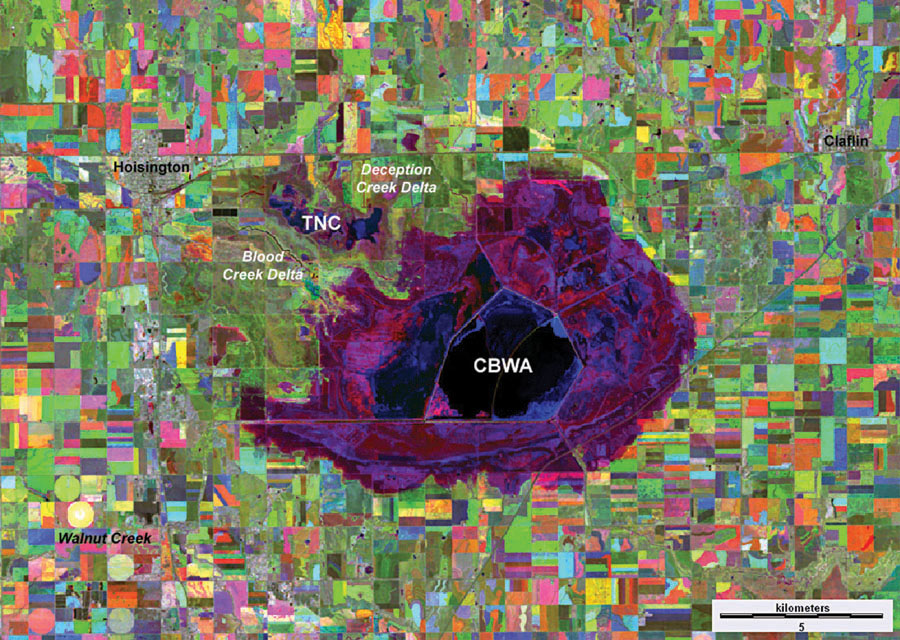
Beginning in 2002, we started research at Cheyenne Bottoms in cooperation with the Nature Conservancy. Our primary methods are various forms of remote sensing--satellite imagery and aerial photography, combined with ground observations. Our goal is to document, analyze, and understand climatic and human impacts on this dynamic wetland environment. Our initial research was funded by a Kansas NASA EPSCoR grant (2002-04). The study is now continuing with support from KansasView, which is part of a nationwide consortium for remote sensing education, research, and geospatial applications.

Superwide-angle photographs

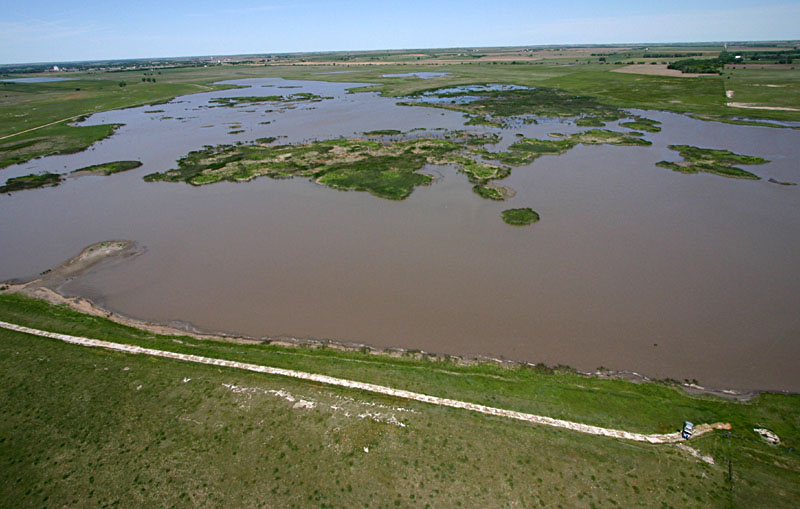
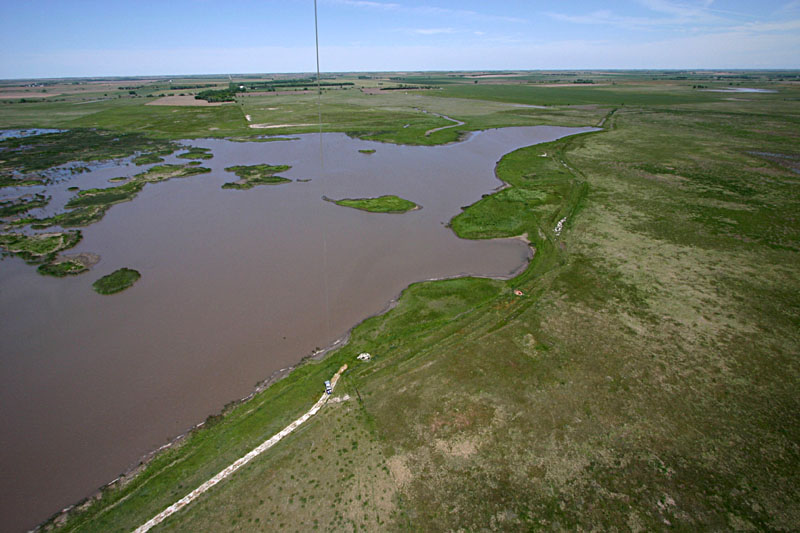
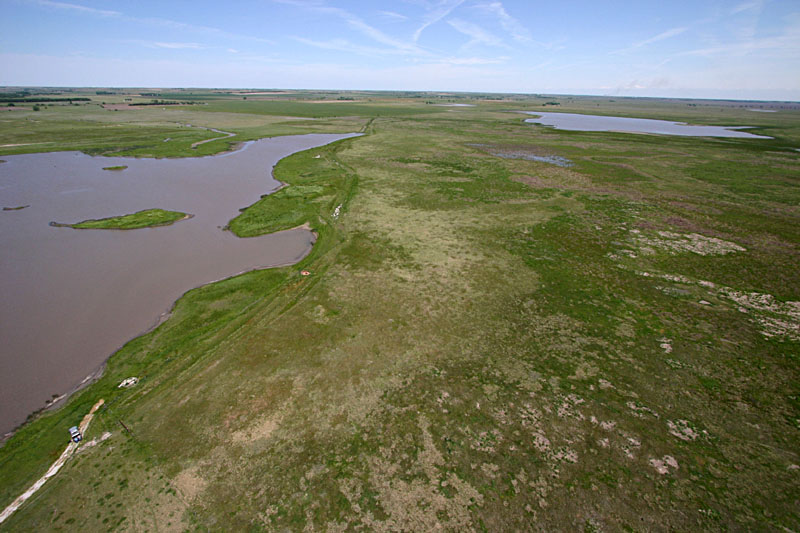
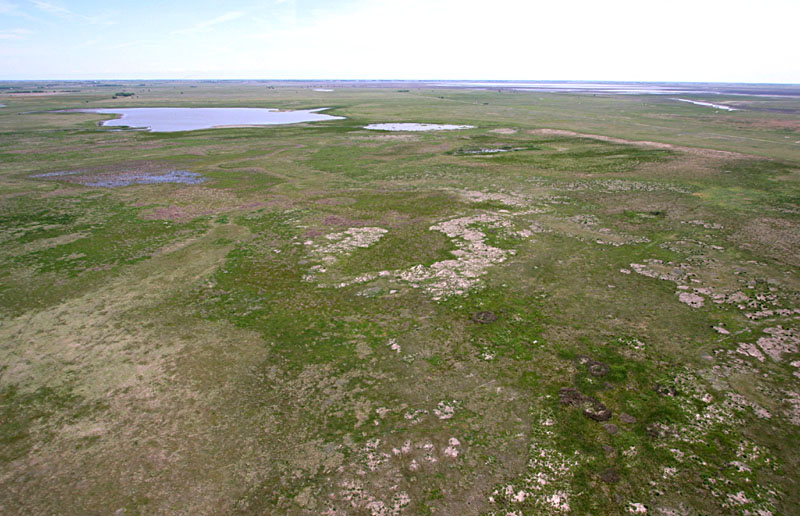
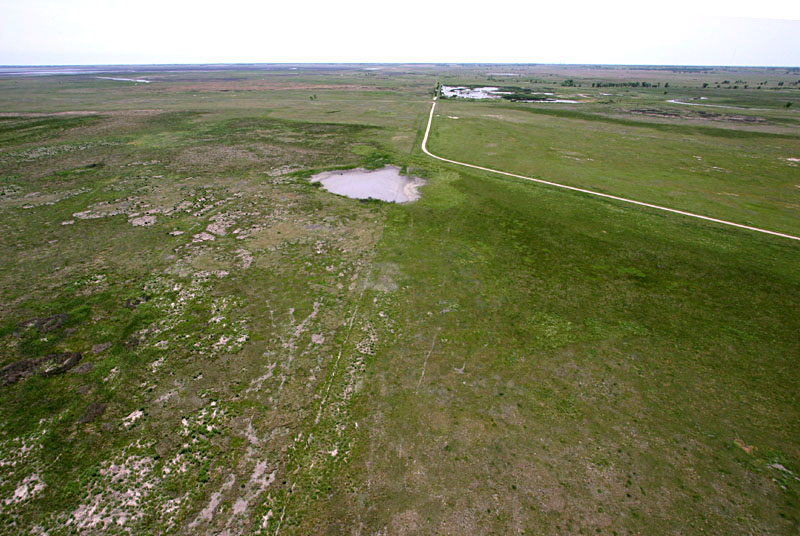
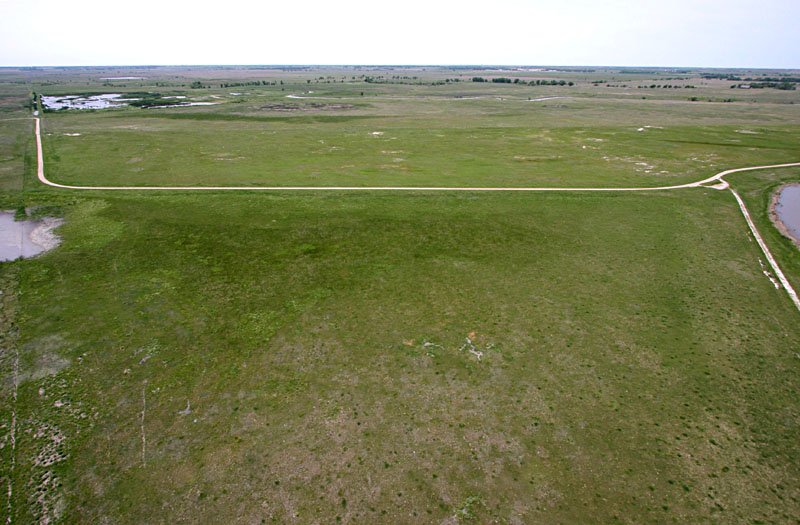
The following kite aerial photographs were taken with a Canon Digital Rebel and 10 mm lens (16 mm film equivalent) in mid-May 2005. At this time, the marshes contained substantial water, and wetland vegetation was greening up nicely. The images are arranged to provide full 360° panorama of the Nature Conservancy marsh complex at Cheyenne Bottoms. The direction toward the center of each view is indicated.
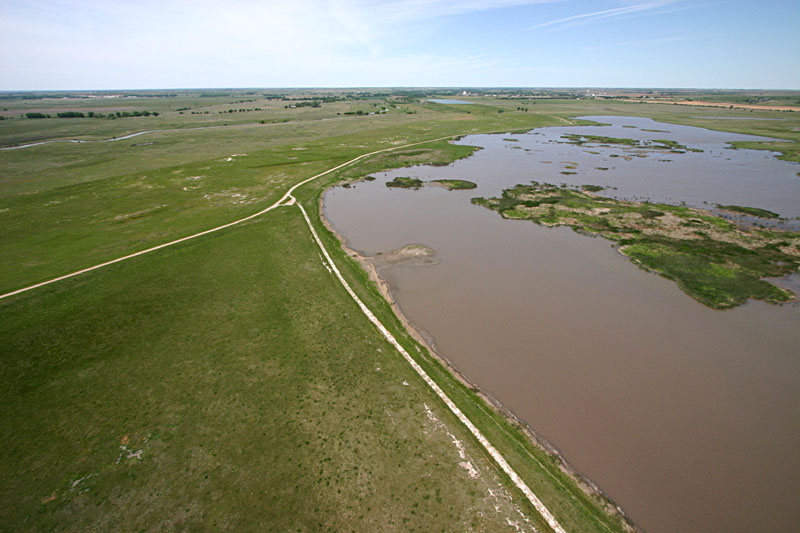

View toward west.

View toward NW.

View toward north.

View toward NE.


View toward east.

View toward south.

View toward SW.

More aerial views of Cheyenne Bottoms.

Wetland vegetation

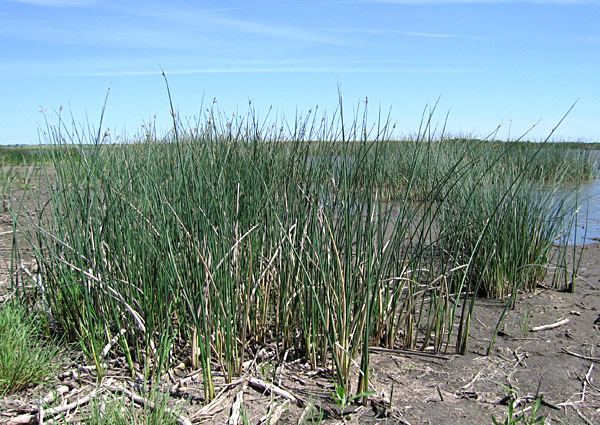
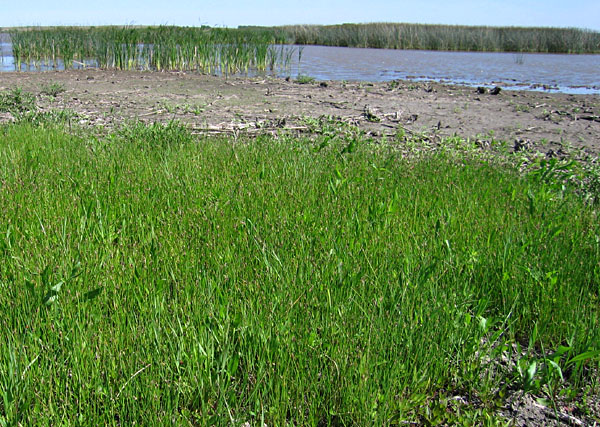
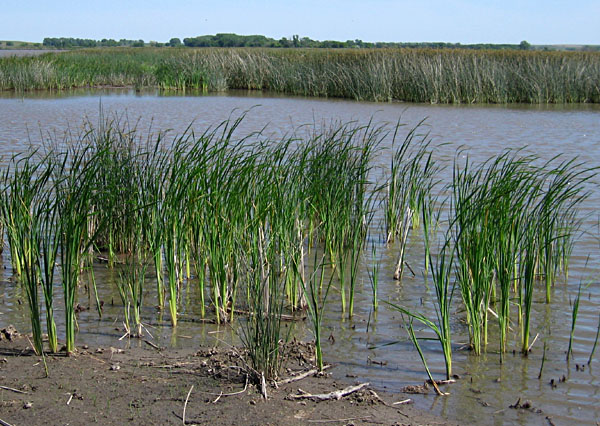
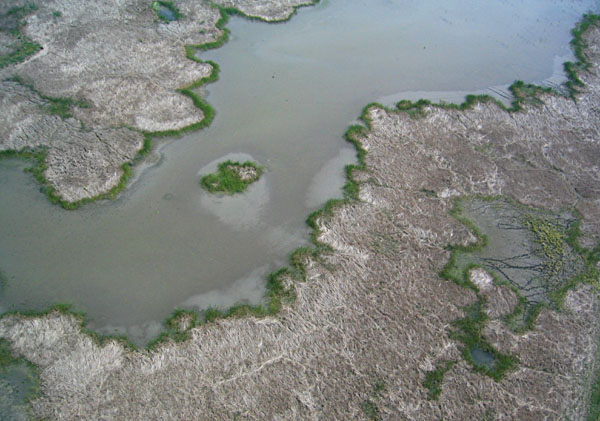
During our investigations we have identified three key emergent wetland plants that are indicators for wildlife habitat conditions in the Nature Conservancy marshes: bulrush, spike sedge, and cattail. These plants thrive or diminish with climatic variations, particularly drought and flood cycles. The marshes were heavily infested with cattail as a consequence of relatively abundant rainfall and high water during the 1990s. When we began our initial observations in 2002, most of the marshes were filled with cattail thickets. However, during a drought (2002-03), the marshes dried up and most cattails died.

Great bulrush (Scirpus validus). Bulrushes are among the most beneficial emergent wetland plants. They may form dense thickets along the margins of water bodies. The seeds are particularly valuable for ducks; bulrush provides nesting habitat, and it binds wet soils quite effectively.
Blunt spike rush (Eleocharis obtusa). Spike rushes are quite common in and diagnostic of wetland environments in temperate regions around the world. They provide shelter for fish, amphibians and insects, and are a food resource for many wetland birds and mammals.
Common cattail (Typha latifolia) and narrow-leafed cattail (Typha angustfolia) have hybridized in the Cheyenne Bottoms vicinity. Among the most common wetland plants worldwide, cattails are invasive in the Great Plains and can displace more desirable wetland plants.

Cattails are considered undesirable for wetland marshes in the central Great Plains. The expansion of cattails converts open marsh and mudflat habitats into dense overgrown thickets, which are unattractive for migrating shorebirds and waterfowl. Cattails may slow or stop the spread of other wetland plants by secreting chemicals that inhibit germination of seeds.

Initial research 2002-05

We begin kite aerial photography of Nature Conservancy wetlands in the spring of 2002, which happened to be the end of a wet climatic phase and the beginning of a drought cycle. We returned repeatedly to the same site to acquire kite and blimp airphotos in different seasons and from year to year.

Kite aerial photographs

Left: healthy cattail beds prior to drought, May '02.
Right: mostly dead cattails during drought, June '03.

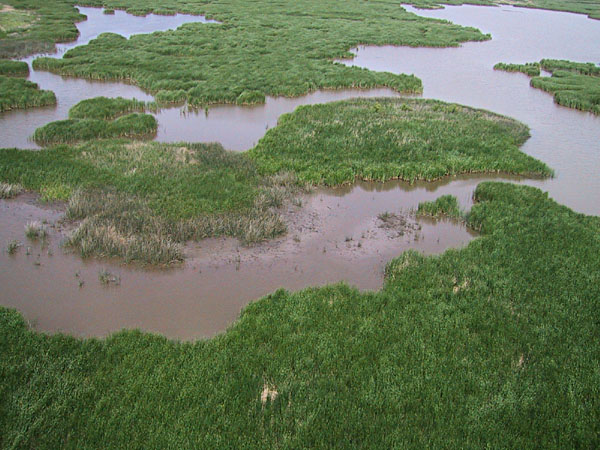
Upon the demise of cattails in early spring 2004, the Nature Conservancy began an experiment in cattail control. Three treatments were applied to different sections of dead cattail thatch. Some areas were mowed, some were burned, and some were left untreated. Since heavy rain refilled the marshes in June 2004, wet weather continued to support regrowth of wetland vegetation through 2005. Bulrush and spike rush spread rapidly to replace cattail in many portions of the marsh, and some small stands of cattail are beginning to come back as well. This resulted in a mosaic of emergent wetland vegetation during the summer 2005.

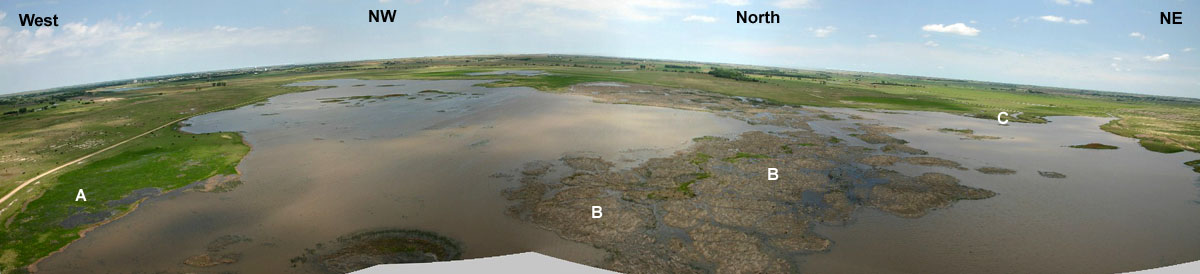
Above: panoramic view assembled from four wide-angle photographs, July 2004. A - former mudflat, now vegetated with blunt spike rush, B - former cattail beds, largely dead following drought, C - delta of Deception Creek.

Below: panoramic image assembled from two wide-angle photographs taken in May 2005. A mosaic of emergent wetland vegetation is evident; darkest green patches in marsh are bulrush.

Continuing research 2005-08

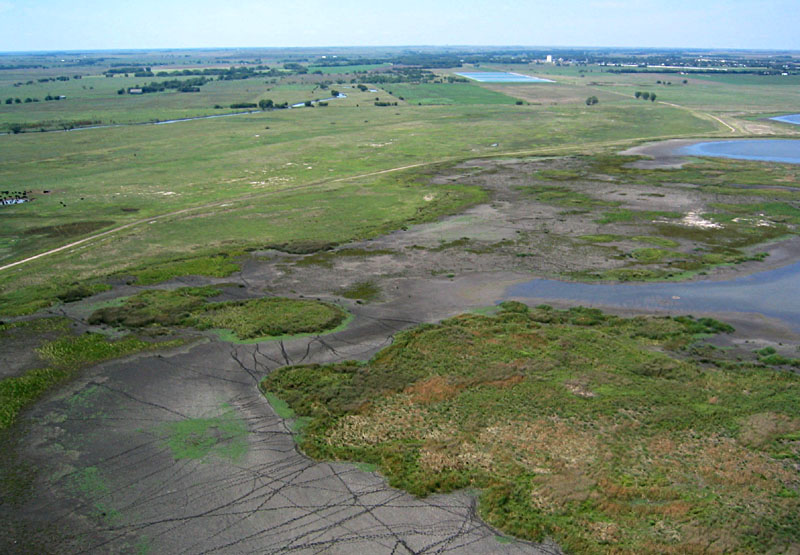
It is our intention to pursue additional research on climatic and human impact on vegetation and water at Cheyenne Bottoms through a variety of ground-based and remote sensing techniques (Aber et al. 2006). In particular, we will continue to monitor details of marsh habitat using small-format aerial photography on a seasonal and yearly basis. The late summer of 2005 began to show signs of diminishing surface water and the potential for drought conditions to develop.

Dry mudflats with cattle tracks (left foreground) and residual water pools (right side) are typical in late summer. Cattle graze on wet meadow in left background. Image date Aug. 2005.

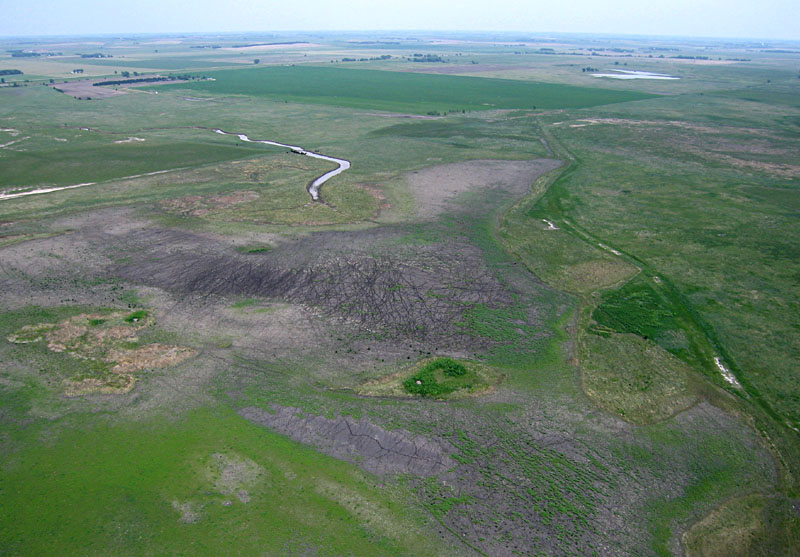
The winter and spring of 2006 were unusually warm and dry. Temperature exceeded 95°F (35°C) already in April, and little precipitation fell through the month of June. As a consequence, Nature Conservancy marshes were completely dry, the state wildlife area had little water, and most inlet creeks and canals were dry. This signaled the beginning of another drought.

View toward northeast over Nature Conservancy marshes. The dry channel of Deception Creek and its delta are visible in upper left portion of scene. Vegetation has spread over dry mudflats in lower left corner. Image date May 2006.
View toward northwest with Hoisington in the far background. All mudflats are dry and vegetation displays limited growth in this scene. Image date May 2006; compare with May 2005 pictures above.

In August of 2006, heavy thunderstorms rumbled across central Kansas, resulting in significant runoff in the vicinity of Great Bend. Flood water was directed via canals and ditches into the state wildlife area of Cheyenne Bottoms, but no recharge happened for marshes in the Nature Conservancy portion of the bottoms. Dry conditions continued there into autumn.

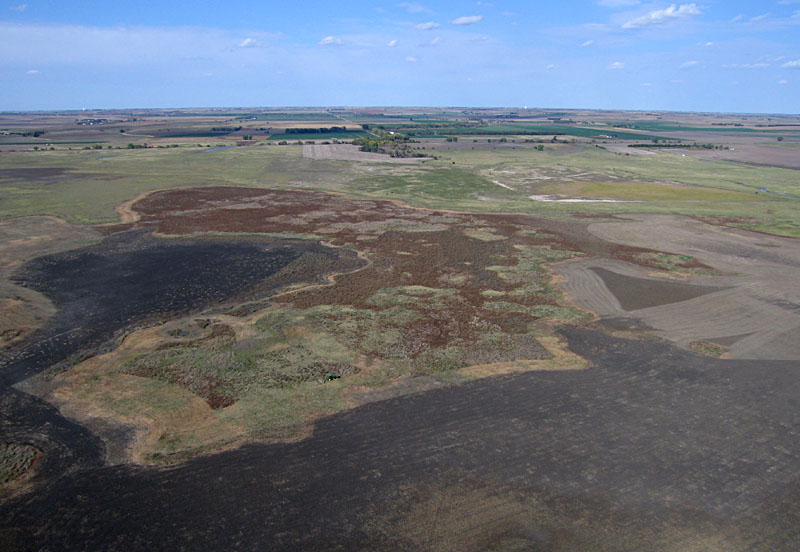
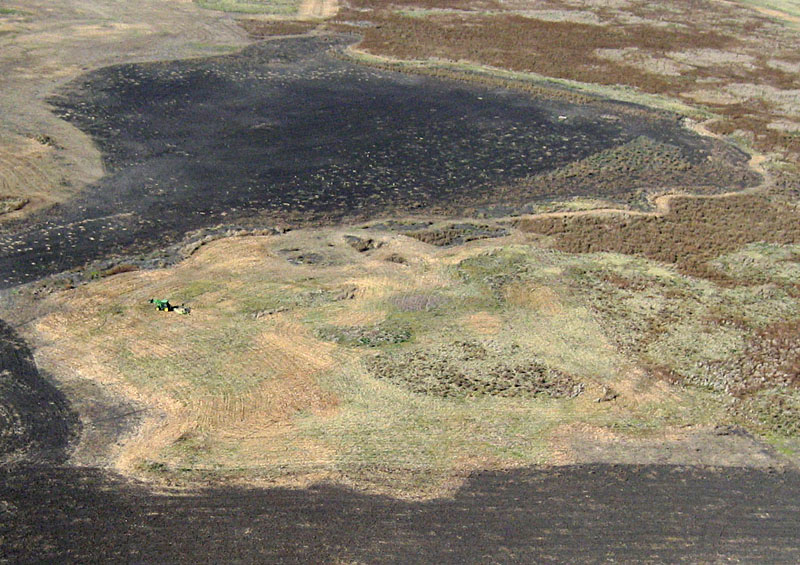
In October 2006, the Nature Conservancy began a systematic effort to control marsh vegetation in mudflats and thickets. Mechanical means were employed; herbicides could not be used for sensitive wetland habitat. Dry mudflats were plowed (disked) in order to remove opportunistic weeds, such as bull thistle and cocklebur. Thickets were mowed to cut down the standing thatch of cattails, bulrush, and other emergent wetland plants. The idea was to simulate heavy buffalo grazing on the dry marsh environment.
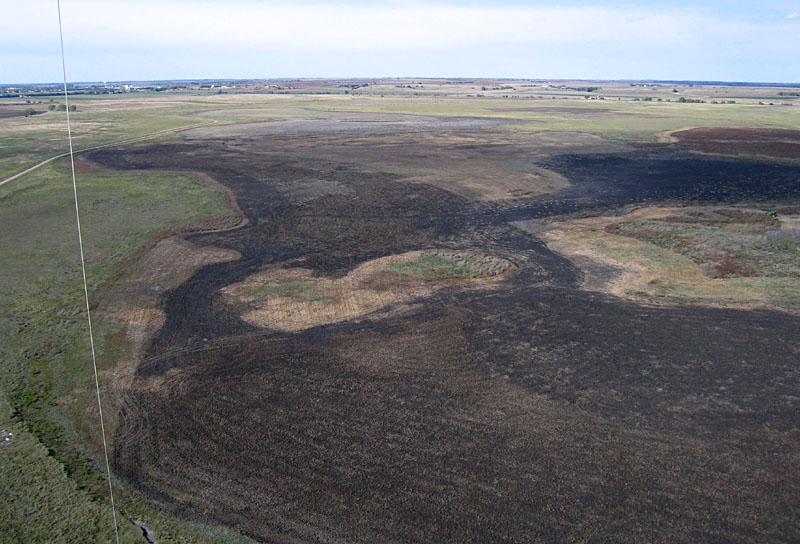
View toward northwest with Hoisington in the far background. The marsh is completely dry and substantial portions have been plowed or mowed. Image date Oct. 2006.
View northward over dry marsh. Bare soil has been plowed and vegetated portions are partly mowed (note tractor). Reddish-brown vegetation is unmowed thickets of cattail and bulrush. Image date Oct. 2006.
Closeup view of tractor mowing down vegetation thicket in raised portions of the marsh. Image date Oct. 2006.

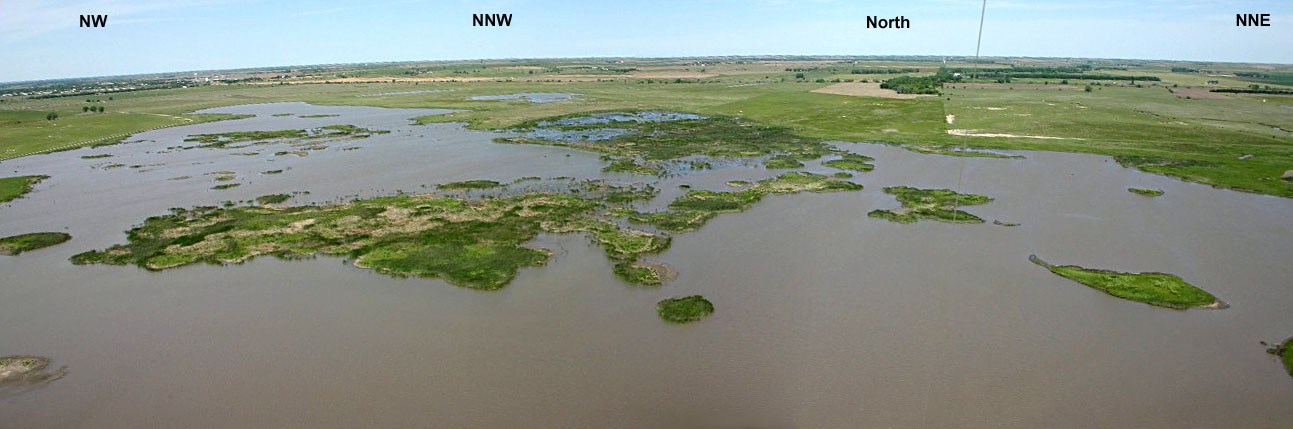
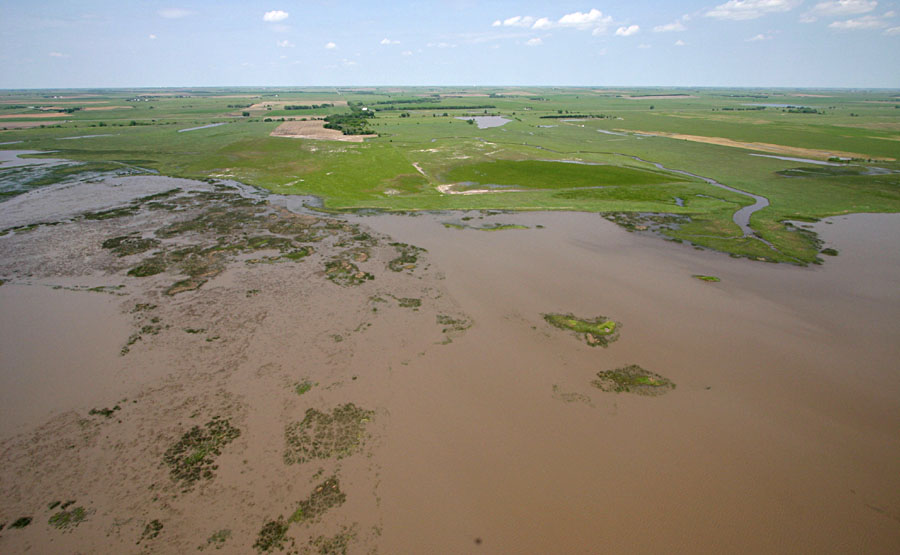
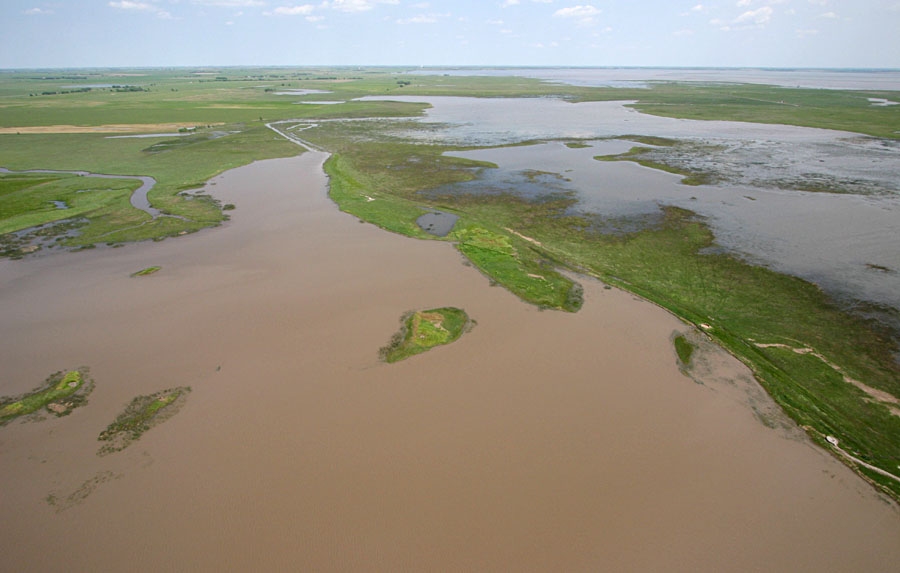
The winter and spring of 2007 were wet. Repeated, heavy rains resulted in flooding of Cheyenne Bottoms in May, when water spread over large portions of the state wildlife area and Nature Conservancy marshes. Marshes were filled to overflowing, and sites that had been dry for many years were inundated. Long-time local residents claim they have never seen so much water in the bottoms. In order to reach our primary study site, we had to drive through water with a 4WD vehicle. The following superwide-angle images document the extent of open water in the Nature Conservancy marshes in mid May. The direction toward the center of each view is indicated.


View toward west.

View toward NW.

View toward north.

View toward NE.

Heavy rains continued through the month of June. The combined May and June rain exceeded 20 inches (50 cm), which set a historical record. Virtually the whole of the state wildlife area was flooded, and about 20% of Nature Conservancy land was inundated (source NC 2007). Considerable damage occurred to roads and drainage structures, but nesting waterfowl was attracted in record numbers. Our field efforts were suspended for the remainder of the year because of impassable roads in study areas.

Latest developments (2008)

Flooding finally began to recede during the winter and spring of 2008. Roads became passable, although water levels remained high in pools and marshes, and we were able to reach our usual Nature Conservancy study site in May and June of 2008. The experiment to simulate heavy buffalo grazing, conducted in fall 2006 (see above), seems to have been successful for creating open marsh conditions, as shown in the following pictures.

Standard view toward the north in early May 2008. Extensive open water remains in the marsh complex. Emergent marsh vegetation is mostly dormant at this time of year.
Standard view toward the northeast in early May 2008. Deception Creek and its small delta are visible in the left background.
Wide-angle view toward the northeast in mid June 2008. Emergent marsh vegetation is active and consists mainly of bulrush with small patches of cattail.
Wide-angle view toward the southeast in mid June 2008. Nature Conservancy marshes in foreground and flooded pools of the state wildlife area in the background.

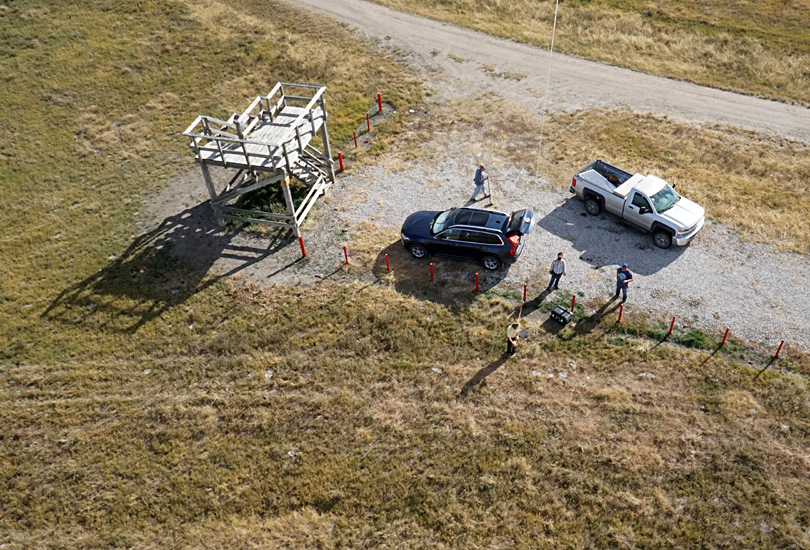
In June, we conducted the first field tests of a new color-infrared digital camera. The Tetracam Agricultural Digital Camera is designed to photograph green, red, and near-infrared portions of the spectrum, specifically 0.52 to 0.92 µm wavelength. The camera employes a special lens to transmit near-infrared radiation, and blue light is excluded. The resulting pictures are false-color images: green appears as blue, red is shown as green, and near-infrared is red.

Tetracam ADC.

Color-infrared photography was initially developed during World War II for camouflage detection. Important scientific applications include vegetation, soil, and water resources. In this format, vegetation appears bright pink and red, because photosynthetically active (green) plants strongly reflect near-infrared radiation. Water bodies, in contrast, strongly absorb near-infrared energy, regardless of water depth or turbidity.

Upon launching the Tetracam camera rig, the crew takes a self portrait. Active vegetation appears in pink and red colors; vegetation is highly reflective for near-infrared, so is much brighter than normal and appears somewhat fuzzy. Note that vehicles and fence poles are sharply defined.
View over Nature Conservancy marsh in central Kansas. Water bodies are quite dark in color-infrared format, although some sun glint is visible in the foreground.
View toward north; compare with visible-color images above. Emergent vegetation (pink) contrasts sharply with water bodies.
View toward northeast; compare with visible-color images above. Deception Creek appears in upper center of scene.

The Kansas Wetland Education Center (KWEC) is under development as a joint venture between the Kansas Department of Wildlife and Parks and Fort Hays State University. Located on the southeastern edge of the state wildlife area, construction was delayed because of flooding in 2007. The building began to take shape in the spring of 2008.

Overview of KWEC looking toward the southeast. Highway K-156 crosses the foreground, and a picnic area is visible in lower right portion. Outlet canal of the State Wildlife Area is toward upper right side. Photo date May 2008.
Closer view of KWEC showing the semi-circular plan of the building and the demonstration marsh behind the building. Photo date May 2008.


Our final visit took place in late September, when water level still remained high following a relatively wet and cool summer. Color-visible (left) and color-infrared (right) views over Nature Conservancy marsh toward the northeast with delta of Deception Creek in the upper left portion.

Author institutions

  1. Emporia State University, Kansas.
  2. University of Southern Maine.
  3. The Nature Conservancy of Kansas.

Other contributors: Chris Banman, Lida Buster, Paul and Jill Johnston, Tamara Korenman, Jo Pfaff, Marcia Schulmeister, Andy Schmidt, Elena Volkova, and John Zupancic.

References


This webpage is presented for general public use and enjoyment.
All rights reserved; text and images © by the authors (2008).

Return to GeoSpectra homepage.